Military Academy
An Officer and a SpyThe Military Academy is the setting for the Dreyfus affair’s most starkly opposed military ceremonies: Alfred Dreyfus’s public degradation and, years later, the ceremony marking his return to the army. It is also where Georges Picquart fights Colonel Henry in a duel. Its parade ground and riding school gather the affair’s central conflicts into a single place, first staging exclusion and later making restoration visible.
Setting and Recurring Spaces
The Military Academy’s grounds include the parade ground, where troops and cadets drill, and a riding school used for Picquart’s duel with Henry. The narrative marks the Academy not only as a site of public military ceremony but as a place Picquart knows from different stages of his career: he was educated there, later taught there, witnessed Dreyfus’s degradation there, and fought Henry in the riding school. That accumulation makes the setting personal as well as institutional. It holds Picquart’s professional history alongside the public consequences of the case.
The approach to the riding school is also part of the location’s significance. On the morning of the duel, several hundred people wait outside, including cadets from the Academy. Troopers guard the entrance; Picquart, arriving in civilian clothes, is jeered by young men of the sort he once taught. The Academy’s surroundings thus register a reversal in his standing: the former instructor returns to a military space where some of its young occupants now treat him as an adversary.
Dreyfus’s Degradation
On the parade ground, a military verdict becomes a carefully staged public performance. At nine o’clock, a command brings four thousand men to attention. Four gunners escort Dreyfus across the ground towards General Darras, their march timed so that their right feet strike with every fifth stroke of the clock. When the escort halts and salutes, the gunners turn away, leaving the condemned man alone before the general. The formation makes the army’s collective presence the frame for an individual punishment.
An official then proclaims the sentence: the court has unanimously ordered Dreyfus’s lifelong deportation to a fortified enclosure, his discharge, and his military degradation before the first military parade of the Paris garrison. General Darras draws his sword and declares, “Alfred Dreyfus, you are not worthy to bear arms. In the name of the French people, we degrade you!” The ceremony gives the verdict a bodily and public form: Dreyfus is isolated before the assembled force and stripped of the status the institution had granted him.
The punishment continues as a march around all four sides of the cour Morland, with Dreyfus in his torn uniform before each detachment. He repeatedly calls out, “I am innocent!”; the watching crowd answers with jeers and antisemitic abuse. The march seems interminable to Picquart, though his watch measures it at no more than seven minutes. The contrast between its brief duration and its intended permanence is sharpened by the narrator’s account: the soldiers are meant to remember how the army deals with traitors, while Dreyfus’s repeated protest remains audible within the spectacle designed to condemn him.
The Riding School and Picquart’s Duel
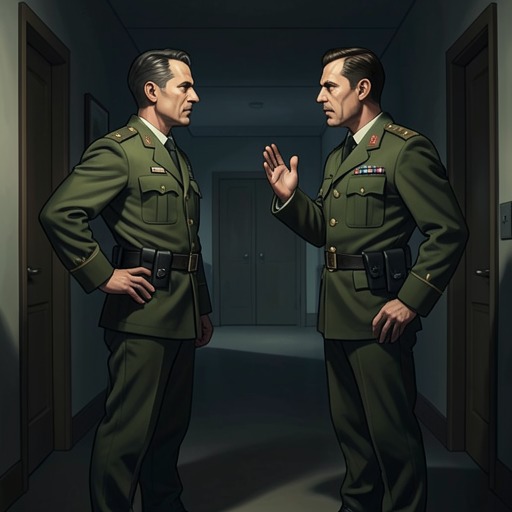
The Academy’s riding school becomes the setting for a different confrontation. The challenge to Henry is delivered at his apartment on the avenue Duquesne, directly opposite the Academy; the duel itself takes place in the riding school. Beforehand, Picquart trains in a barn, relearning the principles of sword attack and parry. On the day, he arrives with Edmond to find the crowd outside and the guarded entrance. Inside, the familiar arena is grey-lit and cold, with straw, ammonia, and the smell of horse manure; trapped birds beat their wings against the skylights.
The space is rearranged for the encounter. A trestle table stands in the middle of the large arena, where Arthur Ranc waits. Picquart is introduced to the adjudicator, a retired sergeant major of the Republican Guard, and to a hospital surgeon serving as his doctor. Henry arrives amid cheers, ignores the others, and goes directly to the table. The adjudicator marks the stone floor with a central line and positions for the combatants, then has both men expose their chests to establish that they wear no protection. Henry avoids Picquart’s gaze. Weapons are weighed and measured, and the rules specify that a fight can stop after a wound unless the injured man wishes to continue. The familiar Academy interior has become a regulated space for a personal and political reckoning.
Return, Memory, and Restoration
The Academy returns in Picquart’s recollection as a landscape layered with the affair’s turning points. Watching cadets drill from behind the railings of the place de Fontenoy, he identifies the parade ground as the place where he was taught, where he taught others, and where he witnessed Dreyfus’s degradation; the nearby riding school recalls his duel with Henry. The same commands and formations that once framed a public humiliation continue to organize military life, but Picquart now sees them through the accumulated history of the case.
That history eventually brings Dreyfus back to the Academy in a changed role. After the Supreme Court of Appeal overturns the Rennes verdict and fully exonerates him on 12 July 1906, a motion the next day restores him to the army as a major and awards him the cross of the Legion of Honour. It passes in the Chamber of Deputies by 432 votes to 32; a separate motion restores Picquart to the army, passing by 449 to 26. Picquart, now in the uniform of a brigadier general, returns to the Academy parade ground for Dreyfus’s medal ceremony. The location that had made degradation visible now hosts an official act of recognition, though the return cannot erase the earlier spectacle or the years separating the two ceremonies.
Narrative Significance
The Military Academy’s recurrence gives the affair a concrete geography of military authority. On the parade ground, the assembled troops and the timed escort transform a contested judgment into a public display meant to fix Dreyfus’s identity as a traitor. In the riding school, the same institution’s controlled space frames Picquart and Henry’s duel. At the end, the Academy again becomes the setting for a formal military gesture, this time recognizing Dreyfus and Picquart.
For Picquart, these are not interchangeable backdrops. His memories join education, teaching, witness, and combat to the same grounds, while the later ceremony places him back there in a rank he had once lost. The Academy therefore carries both the force of institutional judgment and the possibility of its reversal. Its repeated ceremonies show how military standing is publicly enacted—and how a later act of recognition can revise the official record without making the original injury disappear.